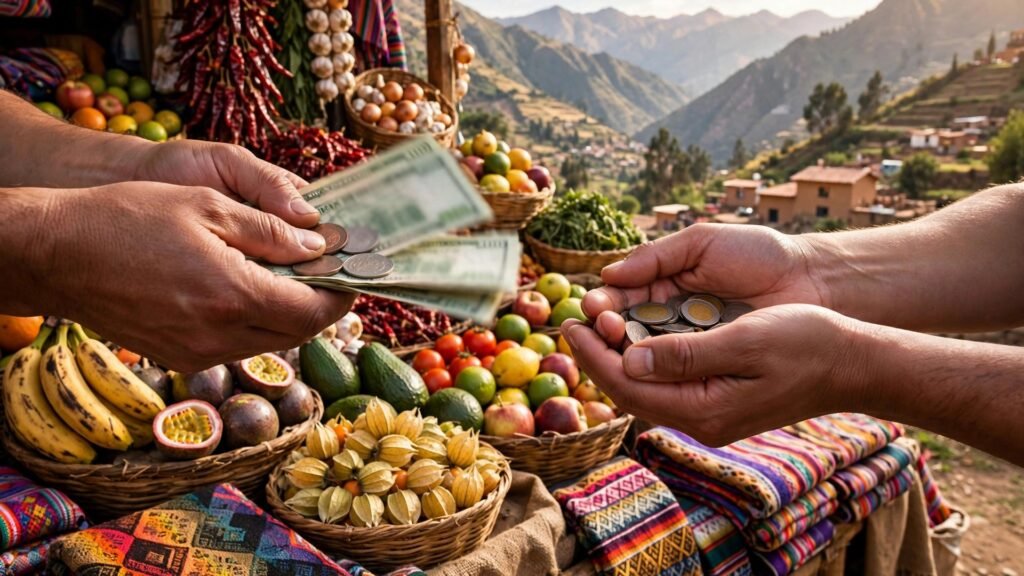
Walk into a shop in Quito, a market in Cuenca, or a roadside stall in the Andes, and the money changing hands will look familiar even if you have never been to Ecuador before. The notes are US dollars. The prices are in dollars. Wages, rents, and savings are counted in dollars too. Ecuador is one of the few countries in the world that uses another country’s currency as its own official money, and visitors often ask the obvious question: why?
The short answer is that Ecuador chose the dollar after its own currency collapsed, and the dollar has stayed because it brought a stability that the old system had lost. The longer answer explains a decision that still shapes daily life in Ecuador today, from market stalls to family budgets.
Key Takeaways
- Ecuador adopted the US dollar as its official currency in 2000, after its former currency, the sucre, lost value sharply and confidence in it collapsed.
- Day to day, dollarization means prices, wages, and savings are all counted in dollars, while Ecuador mints its own centavo coins that circulate alongside US coins.
- The trade-off is lasting: the dollar brings price stability, but Ecuador cannot print its own money or set its own interest rates.
What happened to the sucre?
Before 2000, Ecuador’s currency was the sucre, named after a hero of South American independence. For much of the twentieth century it worked like any national currency. But by the late 1990s, Ecuador was in a deep banking and economic crisis. Trust in the sucre fell away, its value dropped fast, and ordinary people found that the money in their pockets bought less and less. Savings held in sucres lost their worth, and planning even a few months ahead became difficult for families and businesses alike.
In that crisis, the government made a drastic choice: it replaced the sucre with the US dollar. In 2000, the dollar became Ecuador’s official currency. The sucre was withdrawn, and from then on, dollars were the money of everyday life. It was not a gradual reform. It was a clean break, taken because the old currency had stopped doing the most basic job a currency must do: holding its value well enough for people to trust it.
How dollarization works day to day
For most Ecuadorians, dollarization is simply normal life now. A coffee, a bus fare, a month’s rent, and a salary are all priced in dollars. American banknotes circulate freely, and so do American coins. There is one visible local exception: Ecuador mints its own centavo coins, in the same sizes and values as US cents, which circulate alongside American coins and are worth the same. A shopper may receive a mix of US and Ecuadorian coins as change, and both spend identically.
Banks in Ecuador also operate in dollars. Accounts are held in dollars, loans are made in dollars, and cash machines dispense dollars. For people sending money home from abroad, the system is straightforward too: money sent in dollars arrives in dollars, with no conversion step in between. That simplicity is one of the quiet, practical benefits of using a currency that is already accepted around the world.
A shopper may receive a mix of US and Ecuadorian coins as change, and both spend identically.
Why the dollar stuck
The main reason the dollar stayed is stability. When a currency holds its value, prices stop spiralling, savings keep their worth, and businesses can plan. After the chaos of the late 1990s, that stability was exactly what Ecuador needed, and the dollar delivered it. A dollar today is worth the same as a dollar tomorrow in a way the sucre, in its final years, was not.
There is also a confidence effect. People trust the dollar because it is used far beyond Ecuador’s borders and is backed by the world’s largest economy. That trust matters for trade, for tourism, and for anyone deciding whether to save or invest. Visitors benefit as well: travellers from the United States do not need to exchange money at all, and travellers from elsewhere deal with a currency they already recognise.
The pattern is not unique to Ecuador, though the reasons differ from place to place. Across Latin America, people have adapted their payment habits to local conditions, whether that means paying with DeUna in Ecuador, paying with Yape in Peru, or paying by QR code in Bolivia. In each case, the everyday choice follows what is stable, familiar, and easy to use.
What Ecuador gave up
Dollarization is not free. The biggest cost is control. A country with its own currency can set interest rates to suit its own economy and, in a crisis, can create money. Ecuador cannot do either. Its interest rates effectively follow decisions made in the United States, for the American economy, not Ecuador’s. If Ecuador’s economy needs cheaper borrowing while the United States needs tighter policy, Ecuador must live with the American choice.
There is also a practical cost: Ecuador must earn or attract dollars to keep them circulating. A country that prints its own money never runs out of its own currency, but a dollarized country can face a shortage of physical cash if dollars flow out faster than they flow in. That is why exports, tourism, and money sent home by Ecuadorians abroad matter so much to the country’s cash supply.
- Dollarization began in 2000, when the sucre was replaced by the US dollar after a banking and currency crisis.
- Ecuadorian centavo coins circulate alongside US coins at the same value.
- The main benefit is stable prices and trusted savings; the main cost is losing control over interest rates and money supply.
- Because the dollar is used worldwide, trade, tourism, and remittances all run more simply.
What it means for visitors and everyday life
For visitors, the advice is simple: bring dollars, and expect small notes and coins to be useful, since market stalls and small shops may struggle to change large bills. For residents, the meaning runs deeper. Dollarization removed one source of uncertainty from daily life. A family saving for school fees or a small business ordering stock does not have to guess what its money will be worth next month. That certainty is easy to take for granted, but it was precisely what was missing before 2000.
None of this means dollarization solved every economic problem. Ecuador still faces the same challenges as any developing economy: creating jobs, raising incomes, and funding public services. The dollar fixed the currency problem. The rest of the economy still has to be built, job by job and business by business, in dollars rather than in sucres.
What to Watch Next
The dollar is likely to remain Ecuador’s currency for the foreseeable future, because unwinding dollarization would mean asking people to trust a new national currency after the experience of the sucre. The real questions are the ones this article has already raised: whether Ecuador can keep enough dollars circulating through exports, tourism, and remittances, and whether its economy can grow strongly within a monetary system it does not control. Those answers will come not from currency debates, but from the everyday work of Ecuadorian businesses, workers, and families using the dollars in their pockets.