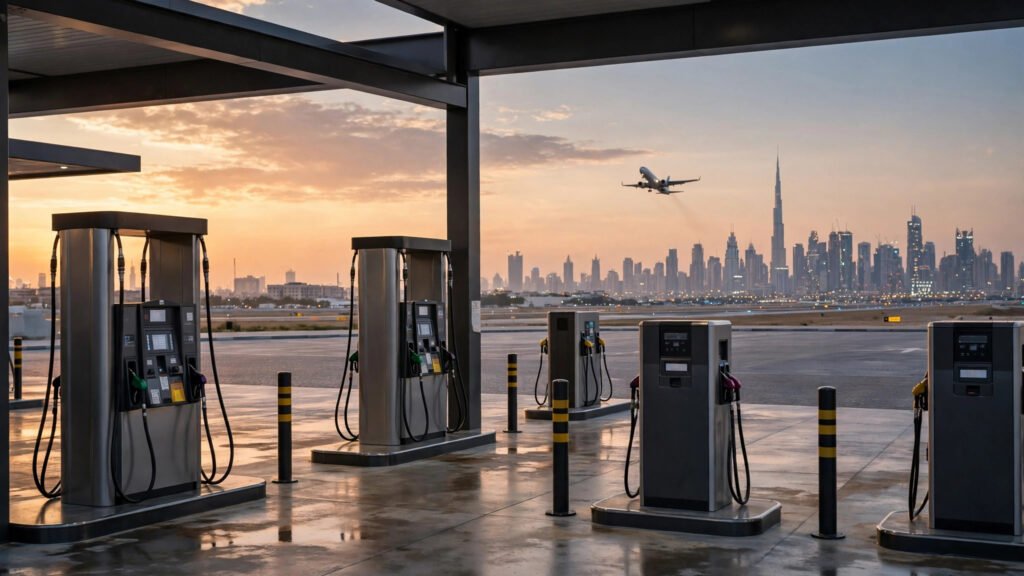
Drivers in the United Arab Emirates are paying less at the pump this month. The UAE Fuel Price Committee has announced lower petrol and diesel prices for November 2026, with the new rates taking effect on November 1.
The cut applies across all three petrol grades. Each grade is 24 fils a litre cheaper than in October, while diesel is 5 fils a litre cheaper. For drivers, the change is straightforward: every litre of petrol costs 24 fils less than it did in October, while diesel is 5 fils cheaper.
Key Takeaways
- UAE petrol prices fell by 24 fils a litre across all three grades for November 2026, and diesel fell by 5 fils a litre.
- Super 98 is Dh4.16 a litre, Special 95 is Dh4.04, E-Plus 91 is Dh3.97, and diesel is Dh4.75.
- Airlines are restoring some Dubai services ahead of winter, but some suspensions continue and travellers are urged to check flight status before leaving for the airport.
The New November Rates
Under the November rates, Super 98 petrol costs Dh4.16 a litre, down from Dh4.40 in October. Special 95 costs Dh4.04 a litre, down from Dh4.28. E-Plus 91 costs Dh3.97 a litre, down from Dh4.21. Diesel costs Dh4.75 a litre, compared with Dh4.80 in October.
The uniform 24-fils cut across petrol grades means the saving does not depend on which grade a driver normally uses. The diesel cut is smaller, at 5 fils a litre, but it still moves in the same direction. The announcement gives motorists a clear, month-long reference price, rather than a daily moving figure, and it arrives at the start of a month when many households are also planning winter travel.
Fuel prices matter beyond the forecourt. Transport costs feed into deliveries, commuting and travel plans, so a cut at the pump is often felt first by drivers and then more widely. In the Gulf, where energy markets and shipping routes are closely watched, a monthly price announcement is also read as a signal about how the authorities see the balance between global oil markets and household costs. Recent pressure on crude supply has kept that balance in focus, with regional security concerns affecting shipping and energy trade.
Flights Return for Winter, With Some Suspensions Extended
Alongside the fuel announcement, airlines are preparing for a winter increase in travel to Dubai. UAE airports are reporting higher seat capacity as carriers prepare for increased passenger demand, and more international services are returning to Dubai ahead of the winter surge.
British Airways is scheduled to resume flights on November 3, one of the clearer return dates in the November picture. At the same time, not every suspended service is coming back at once. Singapore Airlines has extended the suspension of its SQ494 and SQ495 Dubai services until February 28, 2027, a reminder that the recovery in schedules is uneven rather than uniform.
Flight cancellations and delays have also been reported at Dubai International Airport, Zayed International Airport in Abu Dhabi and Sharjah International Airport, including services to Saudi Arabia and other regional destinations. Passengers are advised to check directly with their airlines for the latest flight status, rebooking options and refund arrangements before travelling to the airport, rather than assuming a previously published schedule still holds.
For drivers, the change is straightforward: every litre of petrol costs 24 fils less than it did in October, while diesel is 5 fils cheaper.
Why Travellers Are Watching the Region Closely
The fuel and flight updates arrive against a tense regional backdrop. US President Donald Trump has said negotiations with Iran are progressing, while also saying he is not in a great hurry to reach a deal. US Secretary of State Marco Rubio has said no decision has been made on fresh strikes, but that Washington remains open to diplomacy.
Iran, for its part, has warned of an immediate response to any fresh attack. Supreme Leader Mojtaba Khamenei has ordered military commanders to prepare an immediate and effective response without geographical limitations to any US or Israeli attack, according to the November 1 reporting. Iranian Foreign Minister Abbas Araghchi has said discussions with Qatari mediators are continuing over a proposal to reopen the Strait of Hormuz within two days, provided the US cooperates, a point that matters for global oil supplies and maritime trade.
Tehran has also designated the Royal Navy and Royal Air Force as terrorist organisations and Britain’s MI6 intelligence service as a hostile group, measures that took effect on November 1. At the Manama Dialogue in Bahrain, Saudi Deputy Foreign Minister Waleed Al Khereiji called for diplomatic solutions to regional conflicts and warned that instability threatened maritime security, energy supplies and the global economy. The UAE’s own recent coastal energy incident is a separate reminder of how closely the Emirates watches anything that touches its waters and coastline.
- Super 98: Dh4.16 a litre, down from Dh4.40 in October
- Special 95: Dh4.04 a litre, down from Dh4.28 in October
- E-Plus 91: Dh3.97 a litre, down from Dh4.21 in October
- Diesel: Dh4.75 a litre, down from Dh4.80 in October
- British Airways scheduled to resume Dubai flights on November 3
- Singapore Airlines SQ494 and SQ495 Dubai services suspended until February 28, 2027
What This Means for UAE Residents
For residents, the practical picture for November is a mix of relief and caution. Fuel is cheaper, which helps every driver who fills up during the month. At the same time, air travel still needs a final check before departure, because cancellations, delays and extended suspensions are still part of the schedule picture at Dubai, Abu Dhabi and Sharjah airports.
The advice for travellers is simple and worth repeating: confirm flight timings with the airline before leaving for the airport, watch for airline announcements on cancellations and revised schedules, and follow official UAE advisories for updates on regional developments and travel disruption. Regional airport operations have already been affected by security warnings in recent weeks, as shown by Riyadh airport’s two-week closure, so a last-minute check is not a formality but a practical step.
For households, the fuel cut is the most immediate and certain part of the November story. The new rates are published, they apply from November 1, and they are lower than October on every grade. Whether the saving lasts beyond November will depend on the next monthly announcement, but for this month the direction is clear.
What to Watch Next
What to watch next is simply what the article has already set out: whether the December fuel announcement keeps petrol and diesel at these lower levels or moves them again, whether British Airways resumes as scheduled on November 3 and whether other suspended services follow, whether Singapore Airlines holds its February 2027 date for SQ494 and SQ495, and whether the Strait of Hormuz proposal and the diplomatic exchanges around it change the flight and energy picture for UAE residents. Until the next monthly rates and the next airline updates are announced, the verified picture remains the November one: cheaper fuel from November 1, a partial return of winter flights, and a travel schedule that still needs checking before departure.