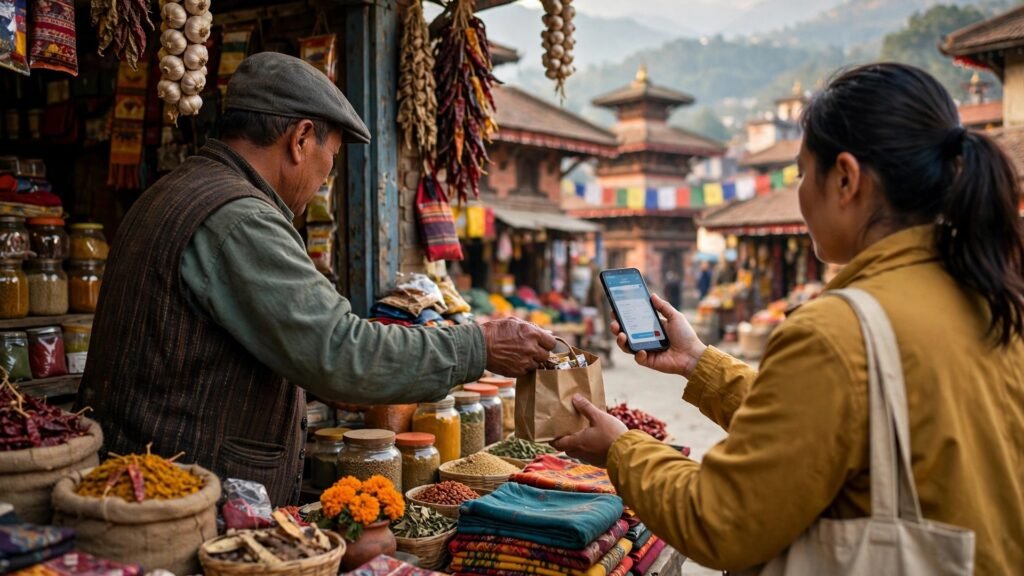
In Nepal, paying with a phone has quietly become an everyday habit. In a Kathmandu shop, at a roadside tea stall, or when settling a bill from home, many Nepalese open a digital wallet on their phone and finish the payment in a few taps. The two names that come up most often are eSewa and Khalti, and their popularity says a lot about how money actually moves in Nepal.
The simple answer is convenience. Cash needs exact change, a safe place to keep it, and often a trip to an ATM or a bank branch. A bank card needs a card machine, and not every small shop has one. A phone, by contrast, is already in the buyer’s hand. When the payment method lives on the device people already carry, it removes several small frictions at once.
Key Takeaways
- eSewa and Khalti fit daily life in Nepal because they run on the smartphones people already carry.
- They let people pay shops, settle bills, top up phones, and send money without carrying large amounts of cash.
- They bridge distance in a mountainous country, where a bank branch can be far away but a phone signal is close.
It Works on the Phone People Already Own
One of the biggest reasons for these wallets’ spread is that they fit the phone people already use. Nepal has seen rapid smartphone adoption, and a wallet app turns that phone into a way to pay, without needing a separate card or device. For a shopkeeper, a student, or a daily-wage worker, that simplicity is the point.
There is no complicated banking process to learn at the counter. Open the app, scan a code or enter a number, confirm, and the payment is done. That low barrier is why a digital wallet feels less like a banking product and more like a basic phone feature, useful for small everyday amounts as well as larger bills.
Open the app, scan a code or enter a number, confirm, and the payment is done.
Cash Is Useful, but Hard to Carry and Keep Safe
Cash still has a place in Nepal, especially for very small purchases in local markets. But carrying cash has clear limits. Notes can be lost or stolen, change can run out at a busy stall, and larger amounts are awkward to transport. A wallet balance avoids those problems: the money stays in the account until it is sent, and the transaction leaves a record on the phone.
That record matters for both sides of a sale. A buyer can check that a payment went through. A seller can confirm it without counting notes in a crowded shop. For small businesses, that confirmation builds trust, and trust is what keeps customers coming back.
Distance Makes the Phone Wallet Especially Useful
Nepal’s geography is part of the story. The country runs from the plains of the Terai to high Himalayan valleys, and in hill and mountain districts a bank branch can be a long journey away. A phone wallet does not remove that distance entirely, but it shortens many everyday tasks: a bill can be paid from home, a phone can be topped up without a trip to town, and money can be sent to family in another district without travelling with cash.
This matters most for routine payments. When a task can be finished from home in a minute, it is simply easier to keep up with than one that needs a journey along a mountain road. That practical advantage is a big reason wallets have moved from a novelty to a default for many people.
It Fits How Families Support Each Other
Money in Nepal does not only move between buyers and sellers. It also moves between family members. Many Nepalese work away from home, whether in Kathmandu, in another district, or abroad, and send support back to their families. A wallet on a phone makes that help easier to receive and use: it can arrive without a long trip, and it can then be spent on shopping, bills, or a top-up.
That family use is one of the quiet strengths of digital wallets. They are not only a checkout tool. They are a way to stay connected financially across distance, and that everyday usefulness keeps people using them long after their first transaction.
- Pay shops by scanning a code or entering a number, without a card machine
- Settle utility bills, internet, and mobile top-ups from home
- Send money to family in another district without travelling with cash
- Keep a record of every payment on the phone
Why Not Just a Bank Card?
Bank cards work well in many places, but they depend on a chain of things: a bank account, a card, and a merchant with a working card machine. In Nepal, that chain is not always complete at the point of sale. A small shop, a tea stall, or a rural trader may not accept cards at all, while a seller with a printed wallet code can accept a phone payment.
The pattern is familiar across South Asia and beyond. In Bangladesh, bKash and Nagad play a similar role for people who prefer phone-based payments over bank cards. In Kenya, too, M-Pesa has become the everyday way to pay for many people. Nepal’s story shares that same logic: the phone came first, and the payment system followed the phone.
Bills, Top-Ups, and Everyday Errands
Beyond shopping, eSewa and Khalti are used for the routine payments that fill a week: electricity and water bills, internet and television subscriptions, mobile top-ups, and small services. Paying these from a phone saves a queue and a journey. A bill that can be settled from home, in a minute, is easier to keep up with than one that needs a trip across town.
That convenience adds up. When one tool handles shopping, bills, top-ups, and family transfers, people stop thinking of it as a special payment method. It becomes the default, and defaults are powerful. Cash and cards remain options, but they are no longer the first choice for every transaction.
The same logic shows up elsewhere. In Uganda, daily life runs on mobile money for many people who do not rely on a bank account for every payment. Each country has its own services, but the reason people adopt them is similar: the phone is already there, the process is simple, and the money moves when it needs to.
What to Watch Next
Nepalese are likely to keep paying with eSewa and Khalti for the same reasons they started: the wallets work on the phones people already carry, they avoid carrying large amounts of cash, they shorten everyday tasks across long distances, and they handle shopping, bills, top-ups, and family support in one place. Cash and bank cards will still have their uses, but the phone has already become the everyday wallet for many people in Nepal, and that habit looks set to stay.