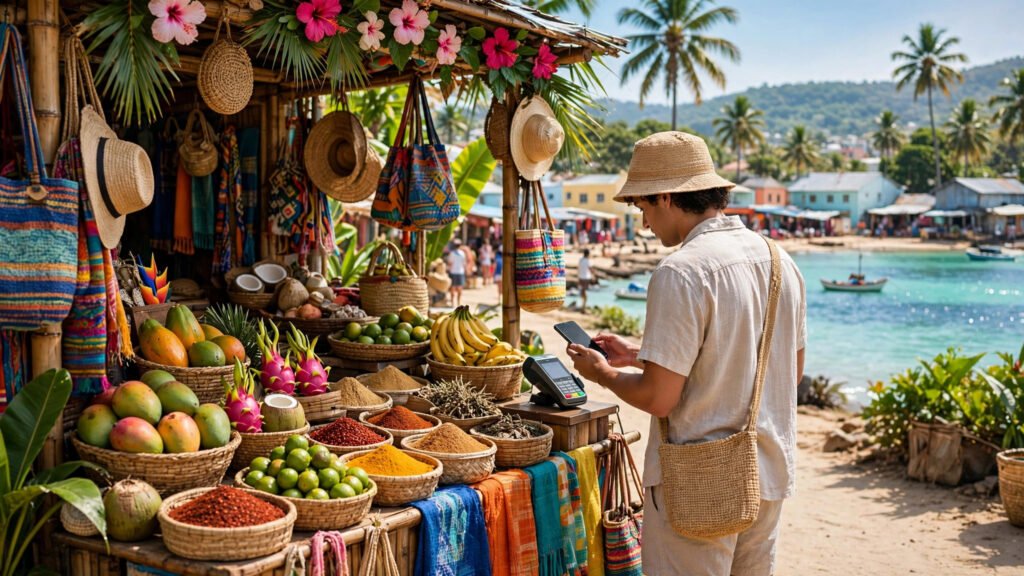
Walk through a market in Port Louis, pay for lunch in Grand Baie, or settle a bill at a small shop in Curepipe, and you will often see the same small gesture: a phone held up, a code scanned, and the payment done. In Mauritius, the phone has quietly become a wallet, and for many people it is now the first thing they reach for instead of notes and coins.
That shift did not happen overnight, and it did not make cash disappear. What changed is the everyday balance. Cash still works everywhere, and bank cards are still widely accepted, but phone payments have become so convenient for daily life on the island that many Mauritians now treat them as the default.
Key Takeaways
- Phone payments in Mauritius centre on mobile wallets and bank apps, with QR codes and tap-to-pay handling many everyday purchases.
- Small shops, markets, food stalls and services benefit because a phone payment needs no change and leaves a clear record.
- Cash still matters for some stalls and small amounts, so most people keep both options rather than relying on the phone alone.
What Changed in Everyday Payments
Mauritius is a compact island, and that compactness helps. Mobile networks cover the main towns and coastal areas well, most adults carry a smartphone, and banks and the national telecom operator have both pushed their own payment apps. The result is an island where paying by phone is practical in daily routines, not just in big shopping malls.
For a long time, cash was the obvious choice for small purchases. It needed no device, no signal and no account. But cash has its own friction: finding an ATM, carrying notes, waiting for change, and keeping track of spending. A phone payment removes most of that. The money moves from one account to another in seconds, and both sides get a record of the transaction.
That convenience matters most for the small, repeated payments that fill a Mauritian day: a bus fare top-up, a coffee, a plate of street food, a top-up for a family member’s phone, or a payment to a tradesperson. When each of those can be settled with a scan or a tap, the phone starts to feel less like an extra and more like the wallet itself.
The Wallets Mauritians Actually Use
Two names come up again and again in conversation about paying by phone in Mauritius. The first is my.t money, the mobile money wallet from Mauritius Telecom, which lets people send money, pay merchants and manage everyday payments from their phone. The second is MCB Juice, the mobile app from the Mauritius Commercial Bank, which combines banking with payments and transfers.
Around those two, the wider picture includes other bank apps and card payments. Many Mauritians already bank with an app on their phone, so paying through that app feels like a small step rather than a new habit. Contactless cards play a part too, especially in supermarkets and larger stores, but the wallet on the phone is what ties the pieces together: one device for banking, messaging, transport and payment.
QR codes are a big part of the story. A small printed code at a shop counter lets a customer scan and pay without the shop needing an expensive terminal. That low barrier matters for small businesses. A market trader, a food vendor or a hairdresser can accept phone payments without a major investment, which is one reason the habit has spread beyond the big retailers. Similar patterns show up in other island economies, where mobile money helps Fijians pay across scattered islands and distance makes a phone wallet especially useful.
When each of those small payments can be settled with a scan or a tap, the phone starts to feel less like an extra and more like the wallet itself.
Why Phones Beat Cash for Small Daily Purchases
There are practical reasons the phone wins for daily spending, and they have little to do with technology for its own sake. They are about time, safety and record-keeping.
- No change needed: a scan settles the exact amount, which suits small shops and busy food stalls.
- A clear record: both buyer and seller can see the payment, which helps with budgeting and with settling disputes.
- Less cash to carry: people feel more comfortable moving around without a pocket full of notes.
- Easy transfers: sending money to family, splitting a bill or paying a bill can be done from anywhere on the island.
- One device, many jobs: the same phone that holds contacts and messages also holds the wallet.
For small businesses, there is another advantage: speed. A queue moves faster when payments are a scan rather than a hunt for change. In a busy lunch spot or a weekend market, that speed is visible to everyone waiting in line, and it encourages the next customer to pay the same way.
Where Cash Still Wins
None of this means cash has vanished from Mauritius. Some market stalls, rural sellers and very small transactions still run on cash, and some people simply prefer it. Older residents, visitors without a local wallet, and anyone whose phone battery has died will all reach for notes at some point. A sensible everyday approach on the island is to carry a little cash alongside the phone, rather than depending entirely on one method.
Connectivity can also matter. Phone payments need a charged phone and a working connection, and while coverage is good in most populated areas, it is not something anyone should take for granted on a remote beach or during a power cut. Cash is the fallback that needs no signal at all, and that reliability keeps it in the picture.
There is also a question of habit and trust. Some people like to see and hold their money, or to keep small spending separate from their bank account. Those preferences are legitimate, and they explain why Mauritius today has a mixed payment culture rather than a single winner. The phone is gaining ground, but it is gaining it alongside cash, not by replacing it overnight.
What Visitors Should Know
For tourists, the practical lesson is simple. Cards are widely accepted in hotels, larger restaurants and shopping centres, and phone payments are increasingly common in the same places. But a visitor who only carries a card may still need cash for a market stall, a small beach vendor or a rural shop. Bringing some local currency and asking before ordering avoids an awkward moment at the counter.
Visitors should also note that some local wallets are tied to a Mauritian phone number or bank account, so a short-stay tourist may not be able to open every wallet a resident uses. Cards and cash remain the reliable fallback for visitors, while residents enjoy the full range of local wallet options. The same QR-code convenience that helps locals is spreading in other countries too, as Malaysians scanning QR codes to pay instead of cash and cards shows, and Singapore’s PayNow system shows how bank-to-bank phone transfers can become an everyday habit.
What to Watch Next
The direction in Mauritius looks steady rather than dramatic. Phone payments are already part of daily life, cash remains a trusted fallback, and small businesses keep adopting QR codes because they are simple and cheap to accept. The interesting question is not whether phones will replace cash entirely, but how far the mix will tilt: more stalls accepting scans, more bills settled from an app, and more people who leave the house with a phone as their main wallet and a few notes just in case.
For now, the Mauritian wallet is best described as a combination. The phone handles most daily payments with speed and a clear record, cash covers the gaps, and cards fill in the rest. That combination, rather than any single method, is what everyday life on the island actually runs on.