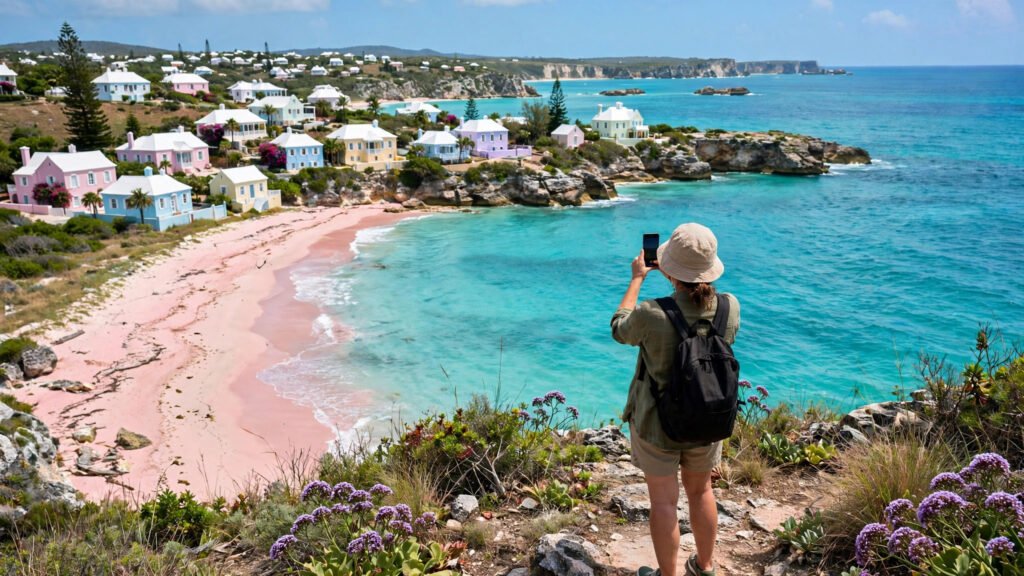
Visitors to Bermuda often notice two things at once: the island is beautiful, and their phone bill starts climbing fast. Locals know the feeling well. Mobile data in Bermuda has a reputation for being expensive, and anyone who streams video, joins video calls, or relies on maps all day can feel it quickly. So why does a small, modern island charge so much for something that feels cheap in many other countries?
The short answer is that Bermuda’s size, its location, and the cost of running networks there all push prices up. None of these factors alone explains the whole story, but together they make mobile data a costly service to provide — and that cost reaches the customer.
Key Takeaways
- Bermuda is a small, isolated island market, so the fixed cost of running mobile networks is shared by relatively few customers.
- Internet traffic reaches the island through submarine cables, and building and maintaining that connection is expensive.
- Residents adapt by using Wi-Fi at home and work, choosing bundles carefully, and saving heavy downloads for fixed connections.
A Small Island Market
Bermuda sits alone in the North Atlantic, hundreds of miles from the nearest mainland. Its population is small compared with the countries whose mobile prices people usually compare it to. That matters because a mobile network has large fixed costs: towers, equipment, licences, staff, and maintenance must be paid for whether a network serves a few thousand people or a few million.
In a large country, those costs are spread across millions of customers, so each person’s share is small. In Bermuda, the same kind of infrastructure serves a much smaller customer base, so each customer’s share is larger. This is one of the main reasons small island markets around the world often have higher telecom prices than big mainland markets.
Geography adds another layer. Bermuda’s settlements are spread across a long, narrow island chain, and coverage must reach homes, workplaces, hotels, and beaches alike. Building and maintaining that coverage on island terrain, exposed to Atlantic weather, costs more than covering a flat mainland city of the same size.
The Cost of Getting Connected
Every photo, message, and video viewed on a Bermudian phone travels off the island through submarine communications cables. Those cables are the island’s lifeline to the global internet, and they are expensive to build, land, and maintain. Repairing a damaged cable at sea is a major operation, and the cost of that resilience is built into the price of connectivity.
Almost everything in Bermuda is imported, and telecom equipment is no exception. Hardware, spare parts, and specialist engineers often come from overseas, and the island’s generally high cost of living feeds into wages, rents, and operating costs for every business — including mobile operators. When the cost of doing business is high across the board, mobile data is unlikely to be the exception.
In a large country, those costs are spread across millions of customers, so each person’s share is small.
Why Competition Is Limited
A small market can only support a small number of mobile operators. Running a full national network is so capital-intensive that there is little room for the crowd of competing providers seen in larger countries. With fewer providers competing for customers, there is less downward pressure on prices.
Regulation also plays a part. Island regulators must balance affordable prices against the need for operators to keep investing in their networks. If prices were forced too low, operators might struggle to maintain coverage and quality; if they are left too high, residents and visitors feel squeezed. Finding that balance on a small island is a constant challenge, and it is one reason prices move slowly even when technology improves elsewhere.
For people living in other island nations, the pattern will look familiar. Islanders everywhere lean heavily on their phones for daily life, from banking to keeping in touch with family overseas — as seen in how Seychellois islanders run almost everything from their phones and why Caymanians bank on their phones instead of visiting a branch — yet island connectivity often costs more than mainland connectivity.
How Bermudians Adapt
Faced with expensive data, Bermudians have learned to use it carefully. Many people lean on Wi-Fi at home, at work, and in public places, saving mobile data for when they are out and about. Streaming and large downloads are often left for a fixed connection, while mobile data is reserved for messaging, maps, and quick browsing.
- Wi-Fi first: homes, offices, hotels, and cafes become the main connection points for heavy use.
- Bundles over browsing: choosing a data bundle in advance usually works out better than paying as you go.
- Downloads before departure: music, maps, and shows are downloaded on Wi-Fi before heading out.
- Settings that save data: low-data modes and automatic-update controls help stretch a bundle further.
Visitors can use the same tricks. Downloading offline maps before leaving the hotel, switching video to lower quality, and turning off automatic app updates all help a data allowance last longer. Simple phone habits also help — making your phone battery last longer goes hand in hand with using data more carefully, since a phone that is constantly searching for signal drains both battery and patience.
What Visitors Should Know
Anyone arriving in Bermuda should expect mobile data to be a real travel cost, not an afterthought. Checking roaming arrangements before departure, or looking into a local option on arrival, can prevent an unpleasant surprise. Hotels and guesthouses commonly offer Wi-Fi, and planning the day’s heavy internet use around those connections is the simplest way to keep costs down.
It is also worth remembering that the high price reflects real infrastructure, not just island life. The cables, towers, and crews that keep a remote Atlantic island connected around the clock are genuinely expensive to run, and every user shares that bill.
What to Watch Next
Mobile data in Bermuda is unlikely to become cheap overnight, because the underlying reasons — a small market, an isolated location, and costly infrastructure — are not going away. What can change is the balance: new cable capacity, network upgrades, and regulatory decisions could gradually ease pressure on prices over time.
For now, the smartest approach remains the one Bermudians already use: treat mobile data as a valuable resource, lean on Wi-Fi for the heavy lifting, and let the phone do what it does best — keeping people connected on a beautiful but remote island.