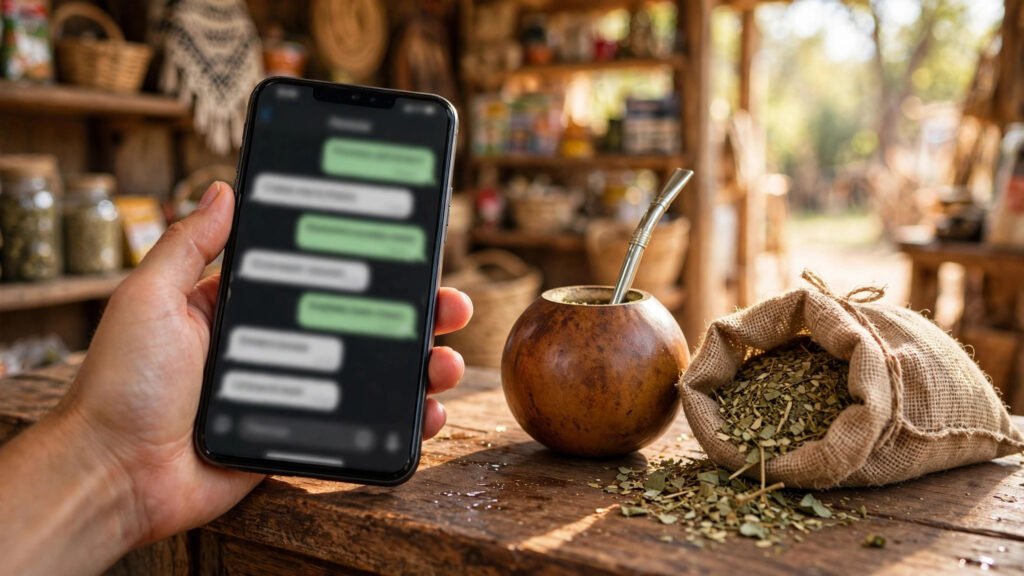
In Paraguay, the messaging app on a phone is much more than a way to send a quick hello. For many Paraguayans, WhatsApp is where daily life gets organised: shopping, work, school, family news and small business all pass through the same green chat screen. Visitors often notice it quickly, because a question that might elsewhere become an email or a phone call is, in Paraguay, usually a WhatsApp message instead.
There is no single reason for this. It is the result of several practical facts coming together: the app is free to download, it works on affordable phones, it runs on a mobile data connection, and almost everyone a person knows already uses it. When an entire circle of contacts is on one app, there is little reason to use anything else.
Key Takeaways
- WhatsApp works on affordable phones and mobile data, so it reaches people across Paraguay without needing a computer or a fixed line.
- Small shops, deliveries and services take orders, confirm times and answer customers through chat instead of formal emails.
- Family, school and community groups keep daily life coordinated in one place, from homework reminders to neighbourhood news.
Why WhatsApp Fits Daily Life in Paraguay
Paraguay is a landlocked country in South America, and much of everyday communication happens on the move: on buses, in markets, on farms and in workshops. A messaging app that works wherever there is a mobile signal fits that rhythm far better than tools that assume a desk, a computer and a stable office connection.
WhatsApp also avoids the cost and formality of traditional texting and calling. Messages, photos, voice notes and documents all travel over the internet connection a phone already has, so a long conversation with a relative, a supplier or a customer does not feel like a meter running. For people who watch their phone credit carefully, that matters.
Another reason is simplicity. The app opens straight into conversations, with no inbox to manage and no subject lines to write. Sending a photo of a product, a location pin for a meeting point, or a short voice note takes seconds. That low effort is part of why the app spread so widely, including among people who do not use a computer at all.
When an entire circle of contacts is on one app, there is little reason to use anything else.
Small Shops, Deliveries and Services Run on Chat
Walk through a market or a shopping street in Asunción, and the pattern is easy to spot. A small shop may not have a website or a booking system, but it will have a WhatsApp number. Customers ask whether an item is in stock, send a photo of what they need, agree a price in chat, and arrange pickup or delivery, all without leaving the app.
The same is true for services. A hairdresser, a repair technician, a tutor or a delivery rider often manages appointments through chat: a message to confirm a time, a photo to show a problem, and a short note when the job is done. In other countries, small businesses have made a similar shift to chat, but in Paraguay the habit extends deep into everyday trade, not just formal businesses.
For the shopkeeper, chat is also a record. The conversation holds the order, the agreed price and the delivery address, so there is less to remember and less to write down. For the customer, it is convenient: the shop is as close as the last message.
Family, School and Community Groups
Beyond business, WhatsApp groups hold much of Paraguay’s social life together. Extended families share news, photos and condolences in a single group chat. Parents’ groups pass on school announcements, homework reminders and event dates. Neighbourhood groups share warnings about a road closure or a lost dog.
These groups matter in a country where many people live far from relatives or have moved to the city for work. A group chat keeps a family present in daily life even when its members are hours apart. People in other scattered or far-flung places rely on their phones in a similar way, because the phone is the thread that holds distant households together.
- Orders, appointments and deliveries are arranged in chat, not by email.
- Photos, locations and voice notes replace long written explanations.
- Group chats coordinate families, schools and neighbourhoods every day.
- The app works on affordable phones and ordinary mobile data.
Voice Notes and Two Languages
One feature deserves special mention: the voice note. In Paraguay, two official languages live side by side, Spanish and Guaraní, and many people switch between them in conversation. A voice note captures tone, humour and the natural mix of languages in a way a typed message cannot, and it is easier than typing for people who are busy, driving or working with their hands.
Voice notes also suit a culture where talking is often warmer than typing. A birthday greeting, a word of thanks or a piece of family news carries more feeling spoken than written. That is one more reason the app feels less like a tool and more like a room where people meet.
What WhatsApp Does Not Replace
None of this means WhatsApp has replaced everything. Banks, government offices and larger companies still use their own systems, and not every task belongs in a chat. Because so much of life now sits on one phone, keeping its photos and chats backed up matters more than ever. And a phone that is lost or broken can temporarily cut a person off from their shop, their customers and their family groups alike.
Still, the balance is clear. Where other countries split daily life across email, phone calls, apps and websites, Paraguay has largely gathered it into one chat app. The result is a style of communication that is fast, informal and always within reach.
What to Watch Next
WhatsApp’s role in Paraguay is unlikely to shrink, because the habits behind it — chat-based shopping, voice notes, and group coordination — are now part of how the country works. The interesting question is what grows around it: whether more shops add simple catalogues inside chat, whether schools and services formalise their group announcements, and whether the app’s newer business features take hold with small traders. Whatever changes, the chat screen will remain, for many Paraguayans, the first place daily life happens.