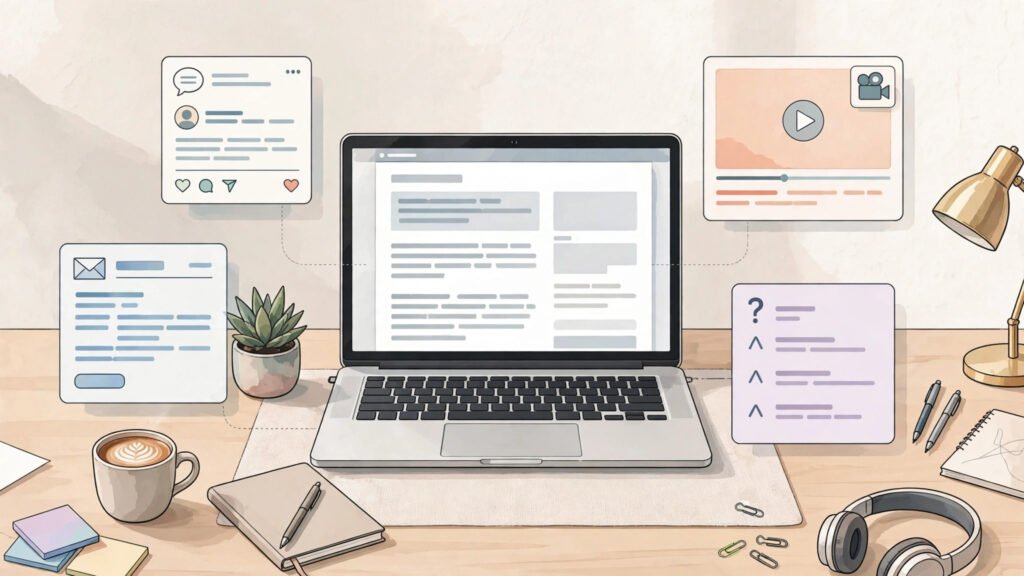
Learning how to repurpose blog content with AI is one of the fastest ways to get more value out of writing you have already done. Instead of starting from a blank page every day, you take one solid blog post and reshape it into several smaller pieces — a short social post, a video script, a newsletter section, and a set of quick answers — so one article can fill a whole week of content. The ideas stay the same; only the format changes to fit where each audience actually reads or watches.
This matters most for small businesses, students, and creators who do not have hours to write every day. One good post already contains the research, the examples, and the structure. Repurposing simply unpacks it. AI tools help with the reshaping — shortening, rephrasing, and reformatting — but the original post is still the source of truth, and every new piece should be checked against it before it goes out.
Key Takeaways
- Repurposing turns one blog post into a week of smaller pieces — social posts, a video script, a newsletter section, and quick answers.
- Start from your strongest post, break it into its main points, and reshape each point for one format at a time.
- Always check AI output against the original article before publishing, so no new piece invents a claim the post never made.
Why Repurposing Beats Writing from Scratch
Writing a brand-new piece every day sounds productive, but it usually leads to thinner content and faster burnout. Repurposing works the other way round: you invest once in a thorough article, then reuse its thinking in formats that reach people who would never read the full post. Someone who scrolls past a long article might still watch a sixty-second video about its main point, and someone who ignores social posts might still open a newsletter.
It also keeps your message consistent. When every piece comes from the same source article, the advice, the examples, and the tone stay aligned instead of drifting from post to post. That consistency is what makes a small creator or business look reliable over time, and it is much easier to maintain than inventing a fresh angle every single morning.
How to Repurpose Blog Content with AI, Step by Step
Step 1: Pick the right post. Choose an article that already covers a topic properly — one with clear sections, practical steps, and examples. A thin post gives AI very little to work with, and the reshaped pieces will be thin too. Your best-performing or most useful post is usually the best starting point.
Step 2: Break it into its main points. List the article’s three to five key ideas, one per line. Each idea becomes one piece of content. A post about budgeting, for example, might split into a tip about tracking spending, a tip about saving first, and a tip about reviewing subscriptions. Working point by point keeps each new piece focused instead of a vague summary of everything.
Step 3: Match each point to one format. Turn the strongest point into a short video script, the most practical point into a social post with a clear action step, and the most surprising point into a newsletter teaser that links back to the full article. If you run a small business, a newsletter written with AI help is a natural home for one of these teasers, since it reaches readers who already asked to hear from you.
Step 4: Let AI draft, then edit by hand. Ask the AI tool to reshape one point at a time, in plain language, for the format you chose — and give it the original text to work from rather than asking it to invent from memory. Then read the draft against the original post, fix anything that drifted, and rewrite the opening line in your own voice. The AI draft is a starting point, not a finished post.
The AI draft is a starting point, not a finished post.
Five Formats One Blog Post Can Become
A single article can realistically become five useful pieces across a week. First, two or three short social posts, each built around one point and one action the reader can try today. Second, a short video script that explains the main idea in under a minute, using the article’s own example. Third, a newsletter section that summarises the post and links back to it for readers who want the full version.
Fourth, a set of short answers: take the questions readers would ask about the topic and answer each in two or three sentences drawn from the article. Fifth, a simple checklist or worksheet based on the article’s steps, which readers can save and reuse. Together these five formats cover readers, watchers, and skimmers without requiring five separate rounds of research.
Keeping the source material organised makes this much easier week after week. If your drafts, images, and notes live in one tidy place, you can find the original post quickly when it is time to reshape it, and organising your digital files with AI can help with exactly that kind of everyday tidying. And once the drafts exist, a careful pass with AI help for editing and proofreading catches the small errors that slip in when text is copied between formats.
- One strong post beats five rushed ones — repurpose the best, not everything.
- Break the article into points first, then give each point exactly one format.
- Feed the AI your own original text; never ask it to invent the content.
- Check every reshaped piece against the original before it goes live.
- End each small piece with a link back to the full article.
Common Mistakes When Repurposing with AI
The biggest mistake is copying the same text everywhere. A paragraph pasted unchanged into a social post, a video script, and a newsletter is not repurposing; it is repetition, and audiences notice quickly. Each format needs its own shape: short and direct for social, spoken and simple for video, and a little warmer and more personal for a newsletter.
The second mistake is skipping the check. AI tools can smooth out wording, but they can also quietly change a meaning, soften a warning, or add a detail that was never in the original. A two-minute comparison with the source article prevents most of these slips. The third mistake is repurposing too soon: a post that is only a day old has not had time to find its audience yet, so let the original breathe before you start slicing it up.
What to Watch Next
Pick your strongest blog post this week, break it into its main points, and reshape just one point into a short social post and one point into a newsletter teaser, checking both against the original before you publish. If that feels manageable, add a short video script next week, keep each format distinct, and always link the smaller pieces back to the full article so new readers can find the complete version.