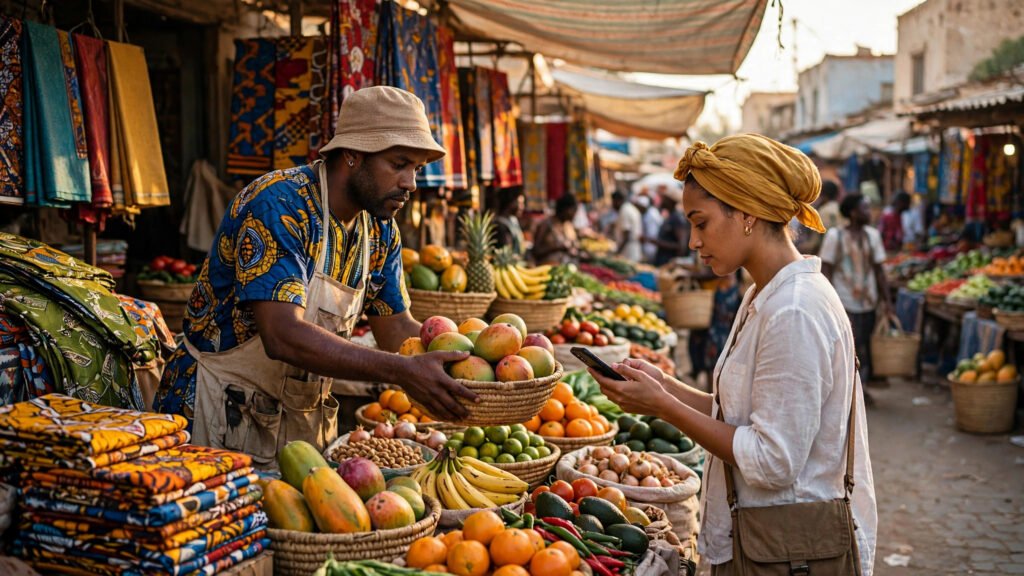
In a busy Dakar market, a customer buying fruit does not always reach for notes and coins. Often, she opens an app on her phone, scans a code or types in a number, and the payment is done in seconds. The vendor checks his own phone, nods, and hands over the bag. For many visitors, that moment is surprising. For a growing number of people in Senegal, it is simply how everyday money now moves.
So why do Senegalese pay with Wave instead of cash and bank cards? The short answer is that Wave fits how life in Senegal actually works. It works through the phone people already carry, it moves money instantly between people, and it reaches places where bank branches and card machines are less common. Cash has not disappeared, and bank cards still have their place, but for small, daily payments, the phone has become the wallet for millions of people.
Key Takeaways
- Wave lets people in Senegal send and receive money through a phone number, without needing a bank card for everyday payments.
- Free transfers between people, QR codes in shops, and a wide agent network made the app easy to adopt for daily life.
- Cash is still used across Senegal, but phones now handle many of the small payments that once needed notes and coins.
Wave was built around the phone, not the bank branch
For a long time, paying without cash in Senegal usually meant having a bank account and a card, and finding a shop with a machine that accepted it. That worked well in large supermarkets and hotels, but far less well in open markets, roadside stalls, small neighbourhood shops and rural towns. Many people earned, saved and spent money without ever stepping inside a bank.
Wave changed the starting point. Instead of asking people to come to a bank, it asked only for a phone. A phone number became the address for money. To pay a vendor, send money to family, or split a bill with friends, people needed the recipient’s number, not an account number or a card reader. That small difference mattered enormously in a country where phones are far more common than bank cards.
The app also kept the process simple. Open it, choose a contact or scan a code, enter the amount, and confirm. There is no card to insert, no slip to sign, and no wait for a machine to connect. For a market trader serving a queue of customers, that speed is not a luxury. It is the difference between a smooth morning and a long line.
Free transfers between people made it spread fast
Wave built its early reputation on transfers between people that did not carry the kind of fee that made small payments feel wasteful. Sending a modest sum to a relative, a friend or a colleague did not feel like a transaction worth avoiding. People tried it once, found it worked, and told others.
That word-of-mouth effect is powerful in Senegal, where family and community networks stretch across cities, towns and villages, and where many people live far from relatives who support them. Money sent from Dakar to a smaller town, or from a worker in the city to family at home, can arrive in moments rather than after a trip to an office or a wait of days. The phone quietly replaced a journey.
Businesses followed people, not the other way around. When customers already had the app on their phones, shops, restaurants, tailors, hairdressers and delivery riders had a reason to accept it. QR codes printed on a counter or shown on a phone screen made accepting a payment as easy as receiving one. The system grew because both sides of the counter already used it.
Agents and small shops brought it beyond the cities
An app alone does not reach everyone. Wave’s agent network helped carry it into neighbourhoods and towns where formal banking is thin. Agents act as human touchpoints: people can put cash into the system, take money out, and get help when something is unclear, all through a familiar local shop rather than a distant branch.
This matters because Senegal’s economy runs heavily on small, informal trade. A fish seller, a fabric merchant, a taxi driver or a market porter does not need a corporate payments terminal. They need a way to be paid quickly, safely and without carrying large amounts of cash at the end of the day. A phone payment answers that need, and an agent nearby answers the question of what happens when cash still needs to enter or leave the system.
The same pattern can be seen in other West African countries, where phone-based money filled a similar gap. In Mali, for example, many people pay through Orange Money instead of bank cards, while in Togo shoppers rely on TMoney and Flooz for everyday payments. Each country has its own leading service, but the reason for adoption is familiar: the phone reaches further than the card machine.
Cash and cards have not gone away
None of this means cash is dead in Senegal, or that bank cards are useless. Cash is still the simplest option in many rural markets, for very small purchases, and for people who do not use a smartphone. Some older traders prefer it, some customers trust what they can hold in their hand, and some transactions simply happen where phone signal is weak.
Cards, meanwhile, still matter for larger purchases, online shopping, travel and formal business. A bank card links spending to an account in a way that suits salaries, bills and bigger transactions. What Wave changed is not the existence of cash or cards, but their share of daily life. For buying lunch, paying a neighbour, sending money home or settling a small shop bill, the phone now wins on convenience.
Security also plays a part. Carrying less cash reduces the risk of losing it or having it taken, and a phone payment leaves a record both sides can check. That record helps traders keep track of the day’s takings and helps customers remember what they paid. In a busy market, that clarity is worth a great deal.
- Wave turns a phone number into a way to pay, so no bank card is needed for daily transfers.
- Instant transfers help families and traders move money across cities and towns without a trip to a bank.
- QR codes and agents let small shops accept phone payments without expensive equipment.
- Cash remains common, especially in rural areas and for very small purchases.
What Wave means for visitors to Senegal
For a visitor, the lesson is practical. In larger hotels and supermarkets, cards usually work. In markets, small restaurants and neighbourhood shops, a phone payment is often the local norm, and cash remains a reliable fallback. Asking a vendor how they prefer to be paid avoids awkward moments at the till, and carrying some cash alongside a card covers the places where neither a machine nor a phone payment is available.
It is also worth remembering that Senegal is not alone in this shift. Across the region, Ivorians pay with Orange Money and MTN MoMo instead of bank cards for many of the same reasons: phones are everywhere, agents are nearby, and sending money to family should not require a bank visit. The names differ from country to country, but the logic is shared.
For small, daily payments, the phone has become the wallet for millions of people.
What to Watch Next
Wave’s rise in Senegal shows how a payment system succeeds when it fits daily life: it works through the phone people already carry, it moves money instantly between people, and it reaches small shops and towns through agents. Cash and bank cards still have their place, especially for larger purchases and in areas with weak signal, but for everyday payments the phone has taken a central role. The next question for Senegal is how far this phone-first habit spreads into bills, transport, online shopping and formal business, and whether cash keeps shrinking as more of daily life moves onto the phone.