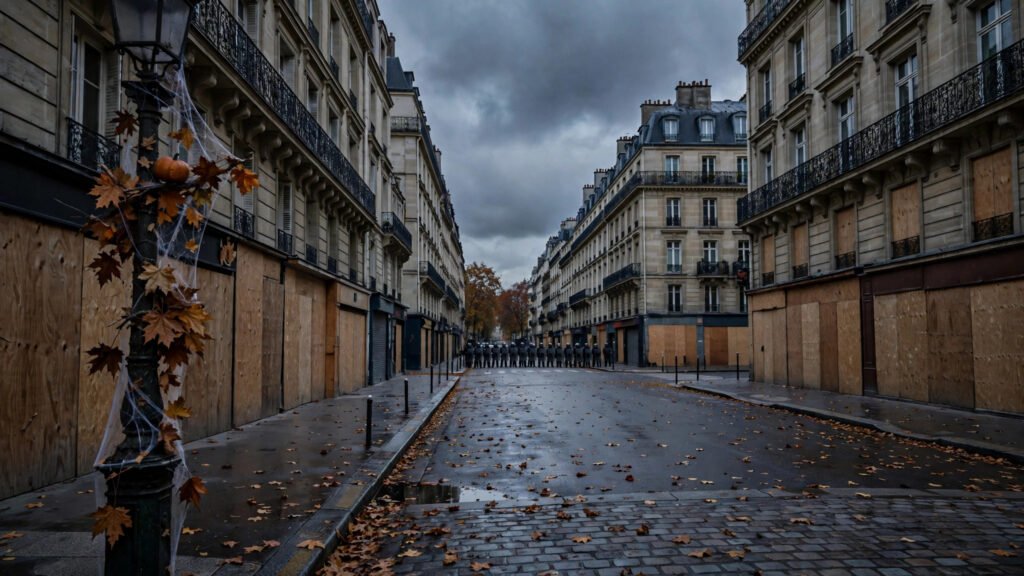
France is bracing for a tense Halloween Saturday, with the government deploying a 70,000-strong police presence across the country ahead of nationwide protests driven by anger over living costs, public services and President Emmanuel Macron’s government. The demonstrations fall on October 31, two weeks after riots and looting caught security forces off guard and left damaged shops, public buildings and businesses in cities across France — and authorities are determined not to be caught out again.
Key Takeaways
- France will deploy 70,000 police officers nationwide on Saturday, October 31, ahead of protests expected to draw large crowds on Halloween.
- Interior Minister Laurent Nunez has warned of a “very high risk” of unrest and promised an extremely firm response to any trouble.
- More than 40 Paris metro stations will close, face-covering masks will not be allowed at demonstrations, and shops in Paris and other cities have boarded up their windows.
Interior Minister Laurent Nunez has described Saturday as carrying a “very high risk” of unrest. “Everyone is on deck to ensure an extremely firm response to any trouble,” Nunez told a news conference earlier this week as he set out the security arrangements. An aide to the minister said street violence on a scale “comparable” to the unrest two weeks ago was expected, a warning that explains the scale of the deployment now under way.
A Capital on Alert
The preparations are visible on the streets of Paris. Shops and businesses in the capital and other French cities boarded up their windows on Friday amid fears of fresh street violence during what will be a third consecutive weekend of protests — this time clashing with Halloween. More than 40 Paris metro stations will be closed on Saturday and tram services will also be disrupted, as authorities move to limit movement around protest routes.
Halloween itself has become a security concern. Authorities are alert to the possibility that rioters could use Halloween masks to conceal their identities, and they have said face-covering masks will not be allowed at the demonstrations. The Paris police prefecture tried to prevent demonstrators from marching between Bastille and Nation in eastern Paris, but a court overturned the ban, leaving the route open and the police operation to manage it instead.
Everyone is on deck to ensure an extremely firm response to any trouble.
The US Embassy has advised travellers to avoid areas where demonstrations or large gatherings are planned, a standard warning that underlines how widespread the expected disruption is. For businesses, the stakes are already high: the unrest two weeks ago damaged or looted thousands of businesses, and the Chamber of Commerce has estimated losses to retailers at more than 1 billion euros.
Why the Protests Keep Coming
The protests gathered pace in late September as Macron’s minority government launched talks on the 2027 budget, and they have since become a rolling test of the president’s authority. France has already seen mass protests this month, and each weekend has added to the pressure on a government trying to push through spending plans without a parliamentary majority.
The political backdrop makes this weekend especially sensitive. Presidential elections are just six months away, and far-right leader Marine Le Pen is leading opinion polls. Macron himself said this week that it was “not normal” for France to be in such a state of “turmoil” so close to a presidential election — an unusually frank admission from a president watching street politics set the national agenda.
The economic backdrop is no easier. France’s economy contracted in the third quarter even as the wider eurozone grew only slowly, leaving households squeezed by living costs at the same time as the government argues over the budget. That combination — falling living standards, contested spending plans and a looming election — is what has kept protesters returning weekend after weekend.
A Movement Spreading Across Europe
What began in France has not stayed in France. The protests have inspired youth-led demonstrations across Europe, with rallies planned in more than 30 German cities on Saturday. More than 160,000 people are expected at Gen Z-led rallies across Germany, demanding better education and lower living costs — the same grievances driving crowds onto French streets, carried across the border by a generation organising largely online.
- 70,000 police officers will be deployed across France on Saturday, October 31.
- More than 40 Paris metro stations will close and tram services will be disrupted.
- Face-covering masks will not be allowed at the demonstrations.
- Shops in Paris and other cities boarded up windows on Friday.
- The unrest two weeks ago damaged or looted thousands of businesses.
- Presidential elections are six months away, with Marine Le Pen leading opinion polls.
What to Watch Next
What to watch next is whether Saturday passes with protests but without a repeat of the looting seen two weeks ago, whether the 70,000-strong police deployment and the metro closures keep the demonstrations contained, and whether the government’s firm response calms the streets or hardens the confrontation. Beyond the weekend, the questions are whether the budget talks ease the anger over living costs and public services, whether the protest movement keeps its momentum into the winter, and whether the turmoil reshapes the presidential race now only six months away. Until those answers emerge, France enters Halloween with its shops boarded, its metro partly shut and its police on the streets in force.