Jordan carried out airstrikes in southern Syria on Monday, saying it was retaliating for a deadly attack on a church in Karak, and Syria responded on Tuesday by closing the Nassib border crossing with Jordan to passengers and commercial traffic in both directions. Syrian authorities reported at least seven people killed in the strikes, including three children, a dispute over whether Damascus had agreed to the operation in advance, and a border closure that cuts the only passenger and commercial crossing between the two countries.
The sequence links two crises in a matter of days: a church attack inside Jordan that killed nine people, and a cross-border military operation that Jordan says targeted the groups behind it. What happens next will turn on two questions that are already in dispute — whether the strikes were coordinated with Damascus, and how long the Nassib crossing stays shut.
Key Takeaways
- Jordan said its air force struck what it described as militant hideouts in southern Syria after the Karak church attack killed nine people.
- Syrian authorities reported at least seven people killed in the strikes, including three children, with three others wounded in preliminary reports.
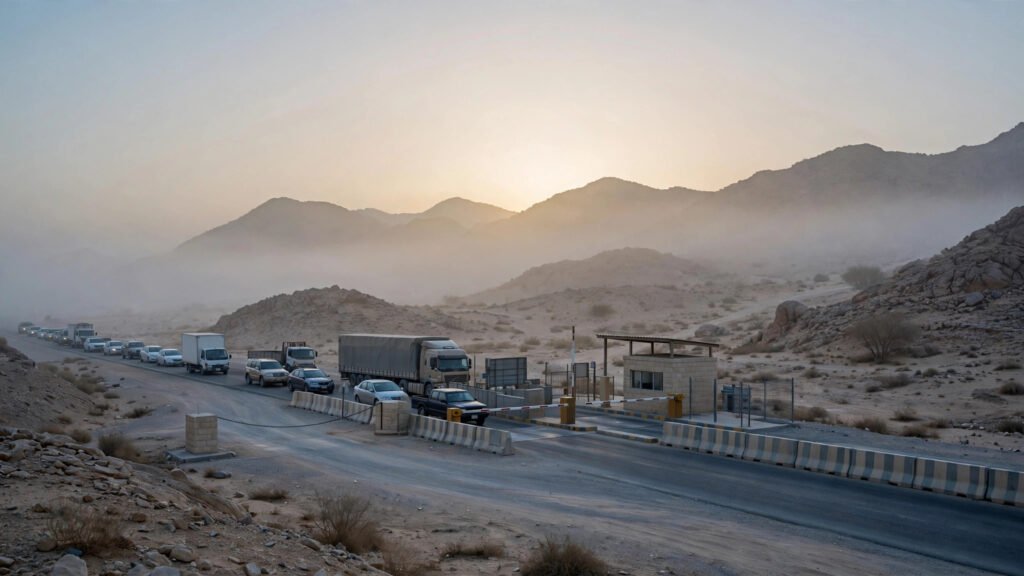
- Syria closed the Nassib crossing on Tuesday, suspending passenger and commercial traffic in both directions, and gave no date for reopening.
What Jordan Said It Struck, and Why
Jordan’s armed forces said the Royal Jordanian Air Force struck hideouts of armed groups in southern Syria that it linked to the attack on a church in Karak on Friday. Jordan’s Ministry of Government Communication said the perpetrators of the church attack were linked to terrorist organisations operating in Syria, and the military said the strikes killed and wounded many members of those groups and destroyed a number of their vehicles.
The church attack was described in reporting as the largest attack against Jordan’s Christian minority since the 1950s. Christians number about 250,000 out of Jordan’s population of about 11 million, and the nine people killed in Karak were all men, mostly from the same prominent family. On Monday, Jordanian authorities said they had arrested three suspects, all Jordanians from the same family, after a manhunt — two brothers and their brother-in-law, according to security officials cited in reporting.
Jordan framed the strikes as a direct response. The National reported the operation as Jordan’s revenge for the church attack, while Reuters reporting described the targets as militant hideouts in southern Syria. The distinction matters: Jordan presented the operation as aimed at the groups behind the Karak attack, not as a wider campaign against Syria itself.
Syria closed the Nassib crossing on Tuesday, suspending passenger and commercial traffic in both directions, and gave no date for reopening.
What Syria Reported on the Ground
Syria’s account of the casualties differed in emphasis from Jordan’s account of the targets. The Syrian Civil Defense said in a preliminary report that seven people, including three children and a woman, were killed and three others were wounded, and that emergency teams responded to four sites hit by the strikes in the countryside of Daraa and Sweida provinces. Daraa’s health directorate reported the same broad picture: three children, three men and a woman among those killed.
Early reports varied as the toll was first assembled, which is common in the first hours after strikes in a border area, but the reports that followed converged on at least seven killed. The Syrian government expressed solidarity with the families affected by the strikes and said authorities were assisting those affected. It also announced an investigation into the strikes and their aftermath.
The strikes landed in Daraa province, in Syria’s south, close to the Jordanian border. That geography is part of why the fallout was immediate: an operation in the border provinces does not stay a military story for long, because the same area carries the road, trade and family traffic between the two countries.
The Coordination Dispute
Jordan and Syria gave directly contradictory accounts of whether the operation was coordinated. Jordan’s armed forces said the strikes were carried out in coordination with Syria. Damascus denied that, saying it had launched an investigation and informing Jordan of its complete reservation over strikes carried out without prior coordination.
Syria’s foreign ministry stressed the importance of field and security coordination in border areas, a point that goes beyond this one operation. If two neighbours cannot agree on whether a cross-border strike was agreed in advance, every future security operation along the same border becomes harder to manage — and the risk of a miscalculation rises. The dispute is therefore not only about wording: it is about who controls security decisions on Syrian territory, and what happens the next time Jordan says it has identified a threat across the border.
The disagreement also sits inside a wider regional picture of strain and diplomacy happening at the same time. In recent days, Saudi Arabia intercepted Houthi missiles and drones while talks involving Iran continued, and officials from the Makkah Pact countries met Iranian counterparts in Tehran to discuss regional security. The Jordan-Syria dispute shows how quickly a bilateral security incident can test those wider efforts.
- Jordan said it struck militant hideouts in southern Syria linked to the Karak church attack.
- Nine people were killed in the Karak church attack, Jordan’s deadliest attack on its Christian minority since the 1950s, according to reporting.
- Syrian authorities reported at least seven killed in the strikes, including three children.
- Jordan said the operation was coordinated with Damascus; Syria denied prior coordination and opened an investigation.
- The Nassib crossing, known as Jaber on the Jordanian side, is Jordan’s only passenger and commercial crossing with Syria.
- Syria gave no date for reopening the crossing.
Why the Nassib Closure Matters
Shortly after the strikes, Syria’s General Authority for Border Crossings and Customs announced on Tuesday that the Nassib crossing would close. The statement cited the current circumstances and developments on the ground in Daraa, and said the suspension covers all passenger and commercial traffic in both directions, out of concern for the safety of travellers and staff at the crossing.
Nassib, known as Jaber on the Jordanian side, is not a minor checkpoint. It is Jordan’s only passenger and commercial border crossing with Syria, and a major overland route for passengers, trucks and trade between the two countries, as well as goods transiting to other regional markets. Closing it does not only stop tourists and family visits: it stops trucks, delays deliveries, and forces traders to wait for a reopening date that Syria has not given.
For people living near the border, the closure is also personal. Families, workers and patients cross at Nassib for reasons that have nothing to do with the politics of the strikes, and a closure with no end date leaves them unable to plan. That human cost is why border closures after security incidents are often short — but also why they are a powerful signal when a government chooses to impose one.
What to Watch Next
What to watch next is only what this article has already set out: whether Syria gives a date for reopening the Nassib crossing, and how long passenger and commercial traffic stays suspended in both directions; whether the investigation Damascus announced clarifies the casualty figures and the four sites reported hit in Daraa and Sweida; whether Jordan and Syria resolve their contradictory accounts of coordination, or whether the dispute hardens into a longer argument over cross-border security; and whether the arrests in Jordan and the strikes in Syria together close the Karak case, or whether further security operations follow. Until those questions are answered, the verified picture remains the one reported on Tuesday: at least seven killed in southern Syria, a coordination dispute between Amman and Damascus, and the only Jordan-Syria passenger and commercial crossing closed.