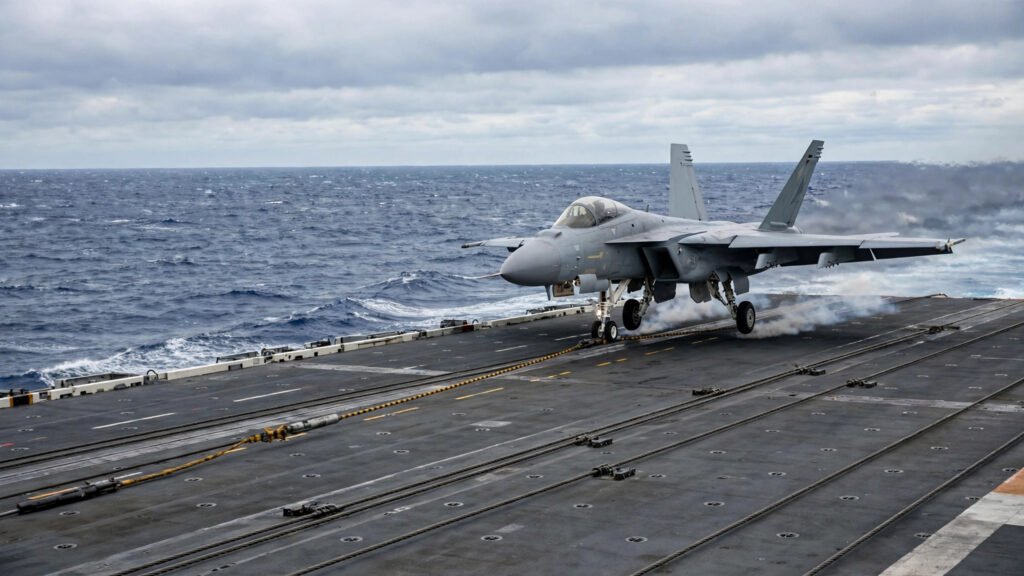
A Rafale Marine fighter jet has landed on and taken off from India’s indigenous aircraft carrier INS Vikrant for the first time, clearing a key milestone in the Indian Navy’s effort to bring the French-built carrier fighter into service. The jet touched down on its maiden attempt on Thursday, October 29, during ongoing carrier integration trials, the Navy said on Friday.
The landing is the first step in a longer process, not the end of it. The trials are designed to test whether the Rafale Marine, built for a very different kind of carrier, can be adapted to operate safely and repeatedly from Vikrant’s deck. If the work succeeds, the jets will eventually replace an ageing fleet and give India a more modern carrier air wing on both of its aircraft carriers.
Key Takeaways
- A Rafale Marine fighter landed on INS Vikrant on its maiden attempt on October 29, 2026, and also completed a take-off trial.
- The Indian Navy described the ongoing trials as the first steps towards operationalising the aircraft in the service.
- India ordered 26 Rafale Marine jets from France in April 2025, with deliveries reported to begin around 2028-2029.
Why the Landing Matters
Carrier landings leave almost no room for error. A pilot must hit a small landing area on a moving deck and catch an arrestor wire, or go around and try again. Doing it on the first attempt matters because it suggests the early deck-compatibility work, including the shore-based trials that came before it, was on the right track. The Navy shared video of the landing on its official account on Friday, a day after the successful attempt.
The Navy said in its statement that the ongoing trials mark the first steps towards operationalisation of the aircraft in the Indian Navy. That wording is important: operationalisation means more than one successful landing. It covers repeated landings and take-offs, handling on deck, maintenance routines, pilot training and the modifications a carrier needs before a new aircraft type can be used in regular service.
The ongoing trials mark the first steps towards operationalisation of the aircraft in the Indian Navy.
The timing also matters for India’s naval planning. INS Vikrant currently operates Russian-origin MiG-29K fighter jets, and the Rafale Marine jets are planned to eventually strengthen that carrier air wing. The new jets are intended for missions including air defence, maritime strike, reconnaissance and shore strikes, according to reports of the programme.
From French Catapults to an Indian Ski-Jump
The central technical challenge is that the Rafale Marine was designed for a different carrier system. The French Navy’s nuclear-powered carrier Charles de Gaulle uses catapults to launch aircraft, a system known as CATOBAR, or catapult-assisted take-off but arrested recovery. INS Vikrant, by contrast, uses STOBAR, short take-off but arrested recovery: fighters take off from a ski-jump ramp at the bow and land with the help of arrestor wires.
That difference is why the trials began on land. A week before the carrier landing, the Navy began trials of the Rafale Marine at its Shore Based Test Facility at INS Hansa in Goa, which replicates a carrier’s ski-jump and arrestor wires, to assess the modifications needed for the jet to operate from Vikrant. French pilots had earlier conducted similar trials at the shore-based facility under a contract signed last year, according to reports.
One reported fit issue underlines why adaptation work is needed. The Rafale Marine’s 10.9-metre non-folding wings are wider than Vikrant’s 10-metre lifts, which are being modified, according to reports. The jets will initially operate from Vikrant and later from the older carrier INS Vikramaditya, where the fit will be even tighter, reports said.
- The Rafale Marine landed on INS Vikrant on its maiden attempt on October 29, 2026.
- INS Vikrant uses a STOBAR system: a ski-jump take-off and arrestor-wire landing.
- India signed a deal in April 2025 for 26 Rafale Marine jets, including 22 single-seat fighters and four twin-seat trainers.
- The deal was reported at about Rs 63,000 crore and includes training, weapons, simulators and long-term support.
- INS Vikrant was commissioned in September 2022 as India’s first indigenous aircraft carrier.
- The Rafale Marine is planned to operate from both INS Vikrant and INS Vikramaditya.
What the Deal Covers
India ordered the 26 Rafale Marine jets from France in April 2025 for the Navy, which will operate them from its two aircraft carriers. The package includes 22 single-seat fighters and four twin-seat trainers, and reports put the value at about Rs 63,000 crore, including training, weapons, simulators and long-term support. Deliveries are reported to begin around 2028-2029, with some reports putting the first deliveries in 2029 and completion by 2031.
Large defence purchases often take years between contract, trials and induction, and the Rafale Marine programme follows that pattern. As with other defence contracts, the headline order is only the start: the aircraft must then be integrated with the ships, crews and support systems that will actually use them. The carrier trials now under way are that integration work in practice.
The regional backdrop adds context to the programme. Naval power in Asian waters is closely watched, and recent combat-readiness patrols around Scarborough Shoal in the South China Sea show how quickly maritime tensions can become visible. India has not linked the Vikrant trials to any single incident, and the trials themselves are presented as a planned step in a procurement programme agreed in 2025, not as a response to a specific event.
INS Vikrant itself is a significant part of the story. Built by Cochin Shipyard Limited and commissioned on September 2, 2022, it displaces about 45,000 tonnes and was India’s first indigenously built aircraft carrier. The Rafale Marine is now the third fixed-wing aircraft type to land on the ship, according to reports, after the trials that have built up its air wing since commissioning.
What to Watch Next
What to watch next is whether the trials continue from this first landing into repeated deck operations, whether the reported lift modifications and other adaptation work proceed on schedule, and whether deliveries begin around 2028-2029 as reported. The other test is whether the aircraft moves from trials towards regular service on Vikrant and later on Vikramaditya, as the Navy described when it called the current work the first steps towards operationalisation. Until those steps are completed, the October 29 landing stands as a milestone in a programme that is still under way, not as a finished induction.