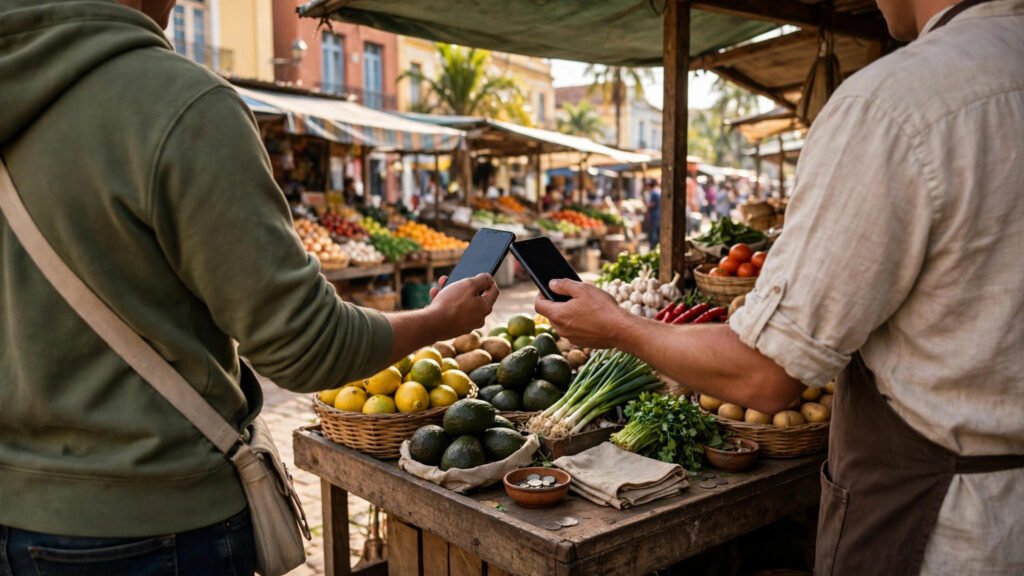
In Paraguay, paying with a phone has become an everyday habit for many people, and one name comes up again and again: Tigo Money. Instead of reaching for a bank card or counting out cash, a growing number of Paraguayans send money, pay bills and settle small purchases from a mobile wallet tied to their phone number. The shift is not about a single app feature. It reflects how people in Paraguay actually live, work and shop — and how mobile money fits those routines better than a traditional bank card sometimes can.
Key Takeaways
- Tigo Money turns a mobile phone number into a wallet, so people can pay and transfer money without needing a bank card.
- Agents and phone-based transfers reach places where bank branches and card terminals are less common.
- For everyday amounts, the phone is simply faster and more convenient than cash or a card.
Tigo Money is the mobile money service of Tigo, one of Paraguay’s main mobile operators. The idea is simple: value is stored in a mobile wallet linked to a phone number, and the phone itself becomes the payment tool. A user can load the wallet, send money to another phone number, pay for services and withdraw cash through authorised agents. No bank account and no plastic card are required to take part, which matters a great deal in a country where many people have a phone long before they have a bank card.
Why a phone wallet fits daily life in Paraguay
Daily life in Paraguay runs on small, frequent payments: a bus fare, a snack from a corner shop, a top-up, a payment to a family member in another town. Cash handles these payments, but it has to be carried, counted and changed. A bank card handles them too, but only where a terminal is available and only for people who hold a card. A phone wallet sits in between — it is as quick as tapping a card, but it works from a device almost everyone already carries.
That convenience is especially visible outside the biggest cities. In smaller towns and rural areas, a bank branch may be a long trip away, while a mobile signal and a local agent are close at hand. Agents — small shops and kiosks that work with the mobile money service — let people put cash into a wallet or take cash out without travelling to a bank. For a worker sending money home, or a parent paying a school-related cost, that short trip replaces a long one.
For a worker sending money home, or a parent paying a school-related cost, that short trip replaces a long one.
Trust also plays a role. Tigo is a familiar brand in Paraguay, and many people already use its network for calls and mobile data. Adding payments to the same phone, with the same number, feels like a smaller step than opening a bank account, learning a new card system and keeping track of statements. When friends, family and local shops already use the same wallet, joining in becomes the practical choice.
What people actually use it for
Most Tigo Money use is gloriously ordinary. People send money to relatives, split a cost with a friend, pay a utility bill or a mobile bill, and buy airtime without hunting for a shop that sells top-ups. Small traders accept wallet payments from customers who do not carry cash, and the money lands straight in the trader’s wallet rather than sitting in a till. Over time, these small uses add up to a habit: the phone becomes the first thing reached for, not the last resort.
- Send money to another phone number, across towns, without a bank visit.
- Pay bills and buy airtime directly from the wallet.
- Cash in and cash out through local agents close to home.
- Accept payments as a small trader without a card terminal.
Similar wallet habits are visible across the region, each shaped by local conditions. In Bolivia, shoppers have leaned into QR code payments at markets and shops, as explained in our guide to why Bolivians pay with QR codes instead of cash. In Ecuador, a bank-backed wallet has taken a comparable everyday role, covered in our look at why Ecuadorians pay with Deuna instead of cash and cards. And in Costa Rica, a phone-number transfer system has become the default for person-to-person payments, as described in our explainer on why Costa Ricans send money with SINPE Movil instead of cash. The pattern is the same everywhere: the tool that fits the phone people already own wins the everyday payment.
Why not just use a bank card?
Bank cards are not absent from Paraguay, and many people do use them, especially for larger purchases and online shopping. But cards come with conditions: an account, an application, a card to carry and keep safe, and a terminal at the other end. For informal traders, market sellers and small service providers, a card terminal can be an extra cost and an extra complication. A phone wallet asks for none of that — if both sides have a phone, the payment can happen.
Cash, meanwhile, still matters, and Tigo Money does not pretend otherwise. Agents exist precisely because cash and digital money must meet: a person can hand over notes and see the same value appear in a wallet, or reverse the process when cash is needed. The wallet is best understood not as a replacement for every payment, but as a bridge — it lets cash, phones and the wider economy connect without forcing everyone through a bank branch first.
What to Watch Next
Paraguay’s payment habits will keep evolving as more shops, services and government payments accept phone wallets, and as bank cards and QR payments spread alongside them. The question to watch is not whether the phone wallet disappears, but how it settles into its role: the everyday tool for small transfers, bills and market payments, used alongside cash and cards rather than replacing them entirely. For now, the reason Paraguayans reach for Tigo Money is straightforward — it is the payment method that is already in their pocket, accepted by the people they pay, and close to where they live.