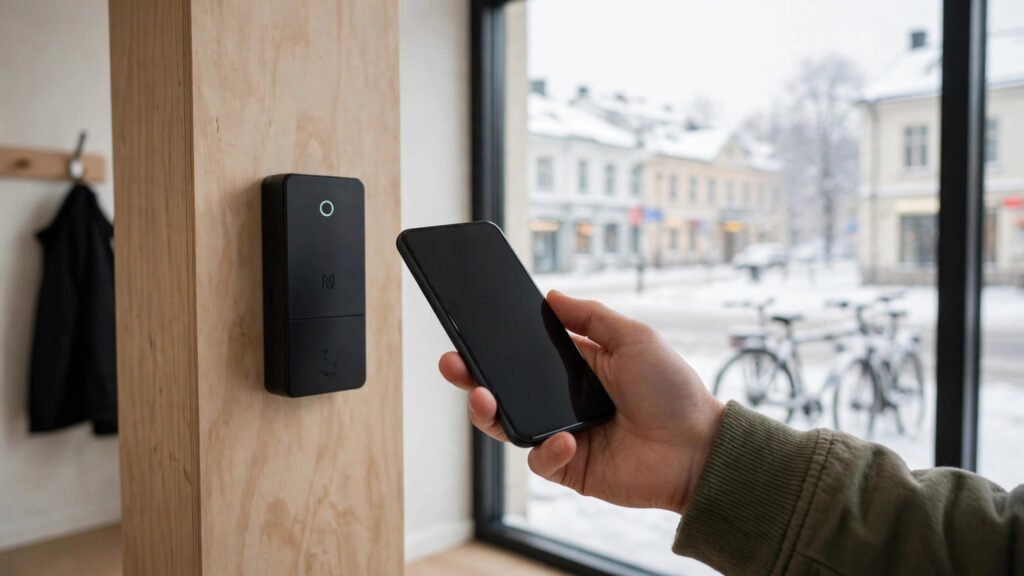
In Finland, the phone in your pocket often does the job of a whole wallet of cards. It can confirm who you are to a bank, open a government service, collect a parcel, or sign a document — all without a single piece of paper. Visitors sometimes find this surprising, but for many Finns it is simply how daily life works. So why do Finns use their phones as ID instead of carrying cards, and what makes that habit feel safe enough to rely on?
Key Takeaways
- One phone check can replace several cards and paper documents for everyday tasks, from banking to public services.
- The habit grew because banks and public offices built services to work online first, with identification built in from the start.
- Trust comes from strong identification checks and the ability to lock a lost phone quickly — but a physical card still matters as a backup.
One Device, Many Doors
The Finnish phone-as-ID habit is really about doors. Each service that once needed its own card, its own queue, or its own paper form now opens with the same device. A bank app confirms identity before showing an account. A public service portal asks for the same kind of check before showing personal records. A parcel locker opens with a code sent to the phone. A library account can live on the phone too. The phone has become the key ring for modern Finnish life: one device that opens the bank, the post office, and the public office.
Finland is not alone in moving daily admin onto the phone. Estonians run much of their lives through e-services too, and the same idea — fewer counters, more self-service — runs through both countries. The difference in Finland is how early and how widely the habit spread, helped by the fact that banks, employers, and public offices all accepted the same kind of phone identification rather than each building a separate system.
Why the Phone Won Trust
Trust did not appear overnight. It grew because the checks behind phone identification feel serious: a code, a fingerprint, or a face check, often combined, before anything sensitive opens. People also know what to do when something goes wrong. A lost wallet means cancelling cards one by one; a lost phone can usually be locked or wiped from another device, and the accounts behind it can be frozen quickly. That sense of control matters.
There is also a practical reason the phone won. Finns were already carrying it everywhere, and it was already the device for messages, maps, and payments. Adding identification to it removed one more thing to remember, rather than adding a new gadget to learn. When a service works the same way on a phone as it does on a computer, people stop thinking of it as a special trick and start treating it as normal.
The phone has become the key ring for modern Finnish life: one device that opens the bank, the post office, and the public office.
Everyday Moments When the Phone Replaces the Card
The clearest sign of the habit is how ordinary it feels. Signing a document online, checking a health appointment, renewing a permit, or confirming identity at a service counter can all start with the phone. Parents handle school matters from it, workers check payslips and tax details through it, and travellers use it to manage bookings and tickets. None of these tasks requires a trip to an office purely to prove who you are.
The phone also fits Finland’s geography and seasons. In a country where towns can be far apart and winter weather can make travel unpleasant, handling admin from home is more than a convenience. It saves a journey, and it means a task can be done in the evening rather than squeezed into office hours. The same logic explains why phones replacing wallets is a wider shift — South Koreans pay with phones instead of cash and cards too, for many of the same reasons of speed and simplicity.
The Wallet Has Not Disappeared
None of this means cards have vanished. A dead battery is the simplest reason: a phone with no charge cannot prove anything, so a backup card stays in many wallets for exactly that moment. Older relatives may still prefer a card and a counter, and visitors or newcomers without Finnish bank credentials often cannot use phone identification at all and must rely on paper documents instead.
There are also places where a physical document is simply the rule, whatever the phone can do. And in remote areas, the phone’s role is different again — Mongolians rely on their phones across the steppe for banking and contact precisely because the nearest office can be hours away. In Finland, the phone-as-ID habit is strongest where coverage, services, and trust all line up, and it is weakest exactly where one of those three is missing.
- One phone check can open banking, public services, parcel lockers, and library accounts.
- Strong identification checks and fast remote locking help explain why Finns trust the phone.
- Handling admin from home saves journeys, especially in winter and in smaller towns.
- A dead battery, an older relative’s preference, or a visitor without local credentials is why a backup card still matters.
- The habit works best where coverage, services, and trust all line up — and weakest where one is missing.
What to Watch Next
The question of why Finns use their phones as ID instead of carrying cards comes down to convenience built on trust: services designed to work online first, identification checks people take seriously, and the ability to lock a lost phone quickly. What to watch next is whether the backup card fades further as batteries improve and services widen, whether visitors and newcomers get easier routes into phone identification, and whether the balance between convenience and caution holds as more of daily life moves onto one device. For now, the Finnish answer is simple: when the phone already opens everything else, there is little reason to carry a separate card for every door.