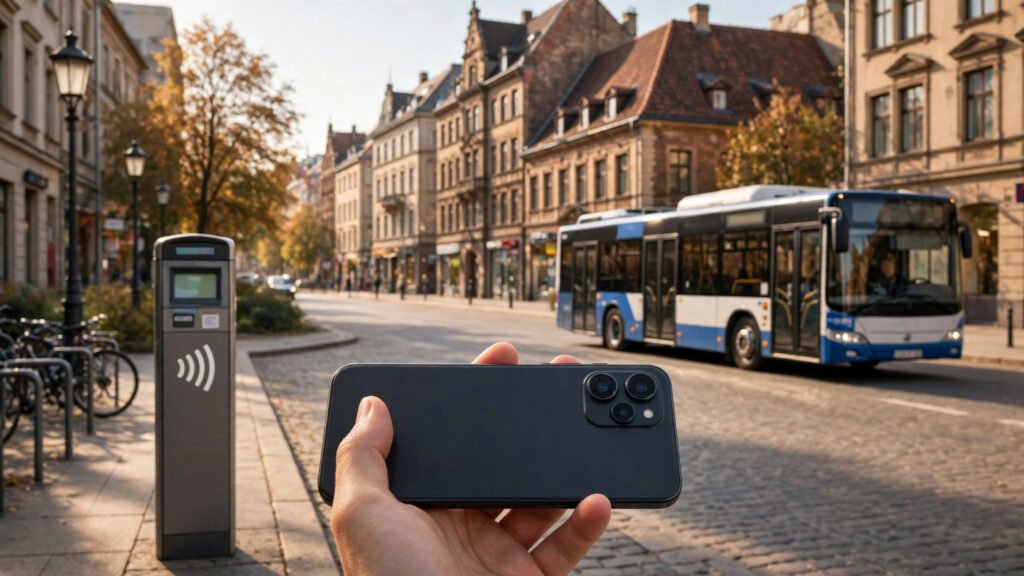
Why the Phone Replaced the Ticket Machine
In Latvia, paying for a bus ride or a parking space from a phone has become an everyday habit, especially in Riga. Instead of hunting for coins, queuing at a ticket machine, or keeping a paper ticket safe for the whole journey, many Latvians open an app, pick what they need, and pay in seconds. The phone has become the wallet, the ticket, and the parking meter all at once.
The shift did not happen overnight. It grew out of practical needs: cities wanted faster boarding on buses and trams, drivers wanted to avoid fines for expired parking, and banks made it easy to pay from a phone. Over time, the habit stuck because the phone version is simply more convenient than the old way of doing things.
- Latvians pay for parking and public transport from their phones because it is faster than coins, machines, and paper tickets.
- Parking apps let drivers start, extend, and stop parking remotely, so they only pay for the time they actually use.
- Mobile tickets live on the phone itself, which means no paper ticket to lose and no machine queue before boarding.
Parking Without Coins or Paper Slips
Parking is where phone payments feel most useful. A driver parks, opens a parking app, selects the zone and the vehicle, and starts the session. If a meeting runs long, the session can be extended from wherever the driver is, rather than by walking back to the car. When the driver leaves early, the session can be stopped, so there is no need to guess in advance how long the stop will last.
Services such as Mobilly, a Latvian mobile payments app, made this pattern familiar: parking, along with other everyday payments, can be handled from one place on the phone. For drivers, the benefit is simple — no searching for coins, no paper slip on the dashboard, and a clear record of the payment on the phone.
This matters most in busy city centres, where parking zones and time limits can be confusing for visitors. An app shows the zone, the session, and the end time in one view, which removes much of the guesswork that used to come with a parking meter.
The phone has become the wallet, the ticket, and the parking meter all at once.
Bus and Tram Tickets on the Phone
Public transport works on the same logic. Instead of buying a paper ticket before boarding, passengers can buy a mobile ticket in an app and keep it on the phone for inspection. There is nothing to print, nothing to lose, and no need to arrive early just to find a machine.
For regular commuters, the phone also keeps everything in one place: tickets, payment history, and any passes they use. For occasional riders and visitors, it lowers the barrier to using the bus or tram, because the ticket is bought the same way as anything else on the phone.
Contactless bank cards have added another option where readers accept them, letting some passengers simply tap to pay. But the app remains the most flexible choice, because it works even when a rider wants a specific ticket type rather than a single ride.
- Parking sessions can be started, extended, and stopped from the phone.
- Mobile transport tickets remove the need for paper tickets and machine queues.
- One phone holds the ticket, the payment record, and the session timer.
- Visitors benefit too, since zones, tickets, and times are shown in one view.
Why Latvians Took to It So Quickly
Latvia is a small, highly connected country, and that helps. Mobile internet is widely available, banking apps are common, and people are used to handling everyday tasks on their phones. When parking and transport joined that list, there was little to learn — it was the same phone, the same kind of payment, just a new use.
Trust also plays a role. A phone payment leaves a record, so drivers and riders can check what they paid and when. That record is reassuring when a parking session or a ticket is ever questioned, and it is something a paper slip never offered as clearly.
The pattern is familiar across the Baltic region and northern Europe. In Estonia, people do almost everything from their phones, and in Lithuania, fast and cheap mobile internet supports the same phone-first habits. Sweden shows the same direction in payments, where Swedes pay with Swish instead of cash or cards for everyday transfers.
What About Cash and Cards?
Phones have not removed every other option. Cash and bank cards still work in many places, and not every rider or driver wants to use an app. Older passengers, visitors without a local app, and anyone with a dead phone battery still need another way to pay, and transport and parking systems keep those options open.
The point is not that the phone replaced everything. It is that the phone became the easiest default for people who already live on their phones, while the older options remain as a backup. That combination — a convenient default plus a fallback — is why the change has lasted.
What to Watch Next
The phone-first habit in Latvia is likely to keep spreading to more everyday payments, as more services move into apps and more riders and drivers get used to paying from one device. Parking and transport showed how quickly a habit can change when the phone version is faster, clearer, and easier to check afterwards. The backup options will stay, but for a growing number of Latvians, the phone is now the first place they reach when it is time to pay.