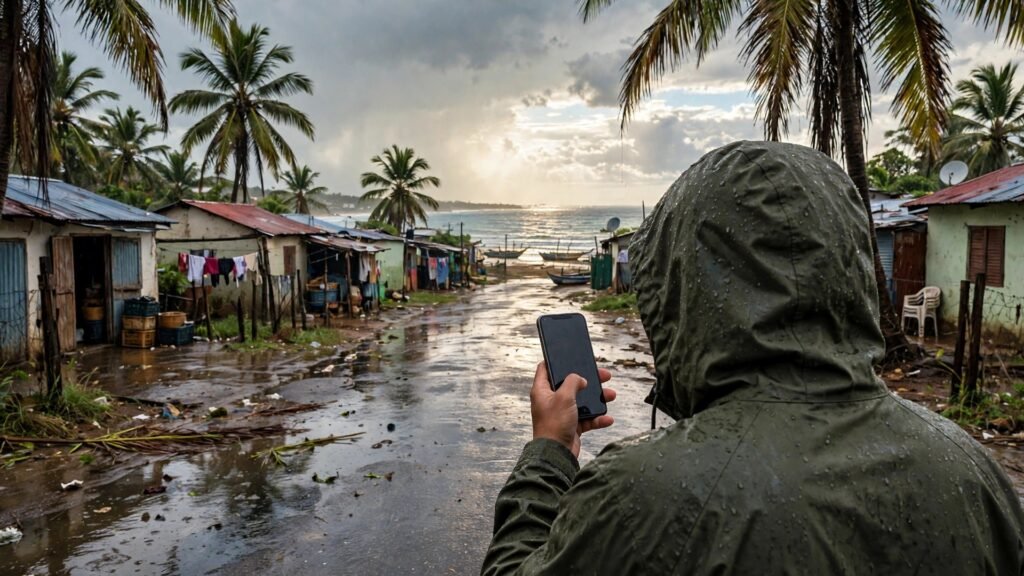
When a cyclone or a flood hits the coast of Mozambique, roads can close, travel can become difficult, and everyday routines can be interrupted for days. In those moments, a phone in a pocket can become one of the most useful tools a family has — not only for news and contact with relatives, but for money itself. For many Mozambicans, sending and receiving money by phone is already part of daily life, and after a storm it can matter even more.
This is not a story about one device or one app. It is about how a country with a very long coastline, many rural communities, and long distances between towns has come to rely on the phone as a practical way to move money when moving in person is hard.
Key Takeaways
- Mobile money lets people send and receive money without travelling to a bank branch, which matters most when roads and transport are disrupted.
- After cyclones and floods, phones help families check on each other, share warnings, and get support from relatives in other towns.
- Keeping a phone charged, protecting its balance, and knowing how to use mobile money safely are practical parts of storm readiness.
A long coastline and long distances
Mozambique stretches along the Indian Ocean, with coastal towns and fishing communities spread over a great distance. Inland, many people live in rural areas far from a city. Travelling between towns can already take time and effort on an ordinary day. When heavy rain floods a road or a storm damages a bridge, a journey that was already long can become impossible for a while.
That distance is one reason the phone matters so much. A person in one town can reach a relative in another town in moments, even when the road between them is closed. And when money needs to move — for food, for building materials, for a bus fare once travel is possible again — a phone transfer can cross that distance without anyone having to make the journey.
Why the bank branch is not always the answer
In many towns, a bank branch may be far away or only open during limited hours. For someone who works during the day, or who lives in a village some distance from the nearest town, a trip to the bank can cost time and transport money. After a storm, that trip can become harder still, because transport may be reduced and roads may be unsafe.
Mobile money changes that calculation. Instead of travelling to withdraw or deposit cash, a person can receive money on their phone and use it through a local agent or for a payment, depending on what is available nearby. The phone does not remove every difficulty — networks can be affected by storms too, and agents need cash and connectivity to serve customers — but it removes one journey that might otherwise stand between a family and the money it needs.
After a storm, a phone transfer can cross a distance that a person cannot travel.
Money from family, when it is needed most
One of the most important uses of phone money after a flood or cyclone is support from family. Many Mozambican families are spread across towns, cities, and sometimes other countries. When a storm damages a home or disrupts work, a relative elsewhere may want to help quickly.
A phone transfer lets that help arrive without waiting for travel to resume. The receiving family can then decide what matters most — food, water, repairs, or transport — rather than waiting for someone to carry cash in person. That speed does not fix the damage, but it can shorten the gap between a storm and the first practical help.
It also works in the other direction. A person who has moved to a city for work can send money home regularly through their phone, and after a storm that same channel is already familiar. There is no new system to learn in a crisis; the family uses a tool it already knows.
Warnings, news, and staying in contact
Money is only part of the story. Before and during a storm, phones carry warnings, weather updates, and messages from local authorities and community groups. People check on neighbours, confirm that relatives are safe, and share information about which roads are open and where help is available.
That flow of information shapes how money is used too. A family that knows a road has reopened can plan a trip to buy supplies. A community that hears about a distribution point can pass the word on. In this way, the phone links the practical question of money to the wider question of safety: knowing what is happening helps people decide what to spend, where to go, and when to wait.
Similar patterns appear in other places where distance or disaster makes the phone essential. In Nepal, for example, people run daily life on their phones across mountain distances, while in Chile, residents check earthquake alerts on their phones first. In the Faroe Islands, islanders rely on their phones across scattered North Atlantic islands. The setting changes; the logic is familiar: when geography makes travel hard, the phone carries what travel cannot.
What makes phone money work after a storm
Several ordinary things decide whether phone money is useful when it is needed most. The first is charge. A phone with no battery cannot receive a transfer or make a call, so keeping a phone charged before a storm — and finding a way to charge it afterwards — is part of preparation, not an afterthought.
The second is network access. Storms can damage masts and power supplies, so service may be patchy for a time. People often try again later, move to higher ground, or wait for service to return. Patience and persistence are part of using a phone in a crisis, and families often plan around the fact that a message may take time to get through.
The third is trust and care. A phone that holds money needs the same care as a wallet. Keeping a PIN private, checking the number before sending, and confirming that a transfer has arrived are small habits that protect a family from loss at exactly the moment when money is hardest to replace.
- Distance first: phone money crosses flooded roads and long gaps between towns without a journey.
- Family support: relatives in other towns can send help through a channel the family already uses.
- Information plus money: warnings and news on the same device help families decide what to do next.
- Preparation matters: charge, PIN safety, and a confirmed recipient number protect money in a crisis.
The limits are real too
It would be wrong to suggest that a phone solves everything after a cyclone or flood. If the network is down, a transfer cannot go through. If local agents have no cash, receiving money on a phone does not immediately become food or materials. If a phone is lost or damaged in the storm, access to its balance can be interrupted until it is replaced or recovered.
For those reasons, phone money works best as one part of a wider response — alongside community help, official relief, and neighbours looking out for each other. The phone is a tool, not a rescue service. Its value is that it keeps one essential channel open — money and information — when other channels are closed.
What to Watch Next
For Mozambicans, the lesson of each storm season is practical rather than dramatic: keep the phone charged, know how to send and receive money safely, and keep contact details for family up to date. As mobile money continues to spread through towns and villages, its role after cyclones and floods is likely to grow — not because the phone replaces roads, banks, or relief efforts, but because it bridges the gap when those things are temporarily out of reach. In a country where distance is a fact of daily life, that bridge matters most precisely when travel is hardest.